Fence Gray Host Failures on OpenShift Virtualization
Configure Node Health Check, FAR, and PowerStore CSI so OpenShift Virtualization fences a hung host that still answers BMC—the gray failure vSphere HA misses.
Personal site note: views expressed here are my own and do not necessarily represent Red Hat or any other organization.
vSphere HA is excellent at the failure it was designed for: the host is gone. Heartbeats stop, the primary declares the host failed or isolated, and protected VMs restart elsewhere from shared disk. A gray failure is the other case. The host still answers management watchdogs and often still ticks datastore heartbeats. Every guest is hung. The initiator keeps the storage fabric busy, so healthy hosts on the same shared array slow down. vCenter stays green. A human issues a hard reset. That reset is a crash for every virtual machine (VM) on the box.
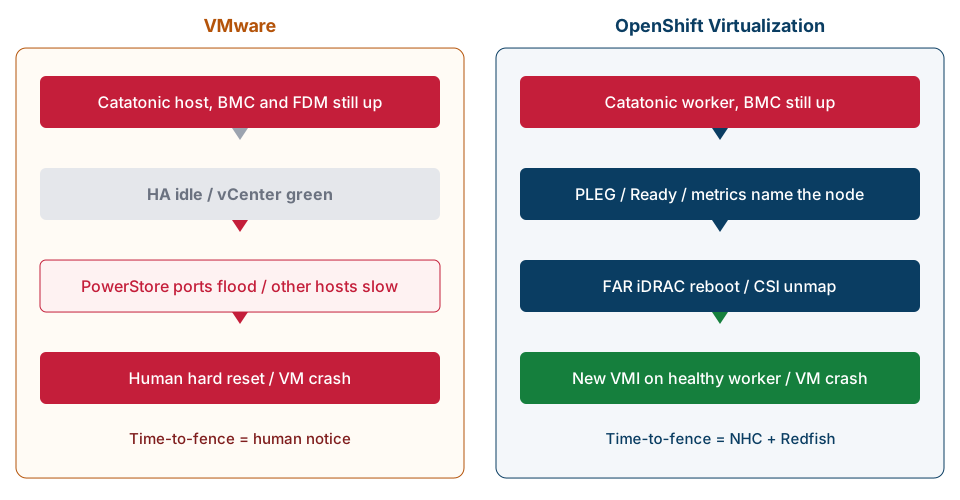
Same failure mode, two control planes. The guest still crashes. The difference is who fences the initiator, and when.
You cannot configure Red Hat OpenShift to stop silicon from going catatonic. You can configure OpenShift Virtualization so that failure is detected, the node is power-cycled, the volume is unmapped, and VMs crash-restart on a healthy worker—without waiting for a human to notice. This post is that configuration, aimed at OpenShift Container Platform 4.22 with Dell PowerStore Container Storage Interface (CSI) as the shared-array example. It is GitOps-shaped, not a click-path through the console.
If you are still building the landing zone itself, start with How to Get Started with an OpenShift PoC and the OpenShift Virtualization (OpenShift PoC) install. Identity and GitOps belong in that sequence before you freeze HA operators: identity providers and OpenShift GitOps. BMC and array passwords belong in External Secrets Operator, not in git.
What “prevent” actually means
Three things stack in a gray failure: detection (the host looks alive), blast radius (shared array frontend ports), and observability (green host object). OpenShift Virtualization HA is not installed by default in a useful form. Without Node Health Check (NHC) and a remediator, the documented fallback is a qualified human deleting the Node object—the same pager as the BMC button.
The sequence you want is:
- Detect from cluster signals (kubelet
Ready, PLEG), not from BMC liveness. - Fence the host with Fence Agents Remediation (FAR) over Redfish / iDRAC.
- Fence the disk with
OutOfServiceTaintso CSI unpublishes the volume. - Recover VMs with
runStrategy: AlwaysorRerunOnFailure.
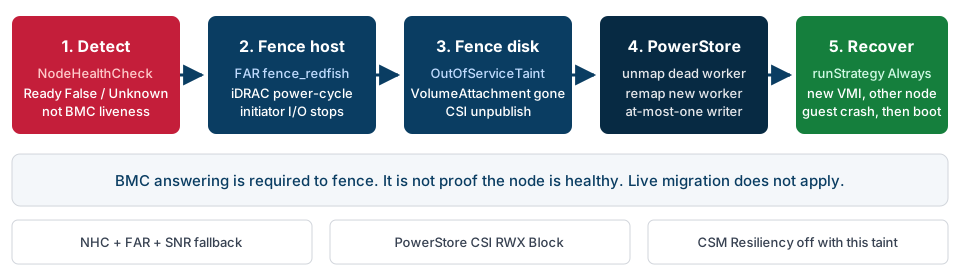
Detect, fence host, unpublish, then start the VM. Never restart a disk-backed VMI while the old QEMU might still write.
BMC answering is required to fence. It is not proof the node is healthy. That is the opposite of how vSphere HA treats management watchdogs in a gray failure. Live migration does not apply; you cannot migrate off a hung host. The guest still crashes. Application clustering still matters. For first-pass Virtualization hardening around those VMs, see Hardening OpenShift Virtualization: First Priorities.
Path B honesty: default NHC only watches
Ready. If kubelet still heartbeats, OpenShift can miss the event the same way vSphere HA did. Close that with a Self Node Remediation (SNR) hardware watchdog, a guest watchdog, and I/O alerts. Do not claim Ready-based HA is complete.
Decisions to lock before YAML
| Choice | Value |
|---|---|
| Worker HA | NHC → FAR (fence_redfish) → SNR if FAR times out |
| Volume revoke | FAR OutOfServiceTaint (not Dell CSM Resiliency) |
| CSM Resiliency | enabled: false — it conflicts with non-graceful node shutdown |
| VM disks | PowerStore CSI, volumeMode: Block, ReadWriteMany |
| Secrets | External Secrets Operator |
| Default MHC | Leave machine-api-termination-handler alone; a custom Ready MHC disables NHC |
| Workers vs control | Two NodeHealthCheck objects. Never mix them. |
Put this in the cluster GitOps repo (namespace → OperatorGroup → Subscription → operands), with sync-wave comments on each resource line in kustomization.yaml. Application GitOps can own VM runStrategy and labels. That split is the same one in GitOps Should Manage ACM, Not the Other Way Around.
Operators: Workload Availability
Install Node Health Check, Fence Agents Remediation, and Self Node Remediation from redhat-operators into openshift-workload-availability. Channel stable, installPlanApproval: Manual. Wait for ClusterServiceVersions to reach Succeeded before you apply templates.
1
2
3
4
5
6
7
8
9
10
11
12
13
14
15
16
17
18
19
20
21
22
23
24
25
26
27
28
29
30
31
apiVersion: v1
kind: Namespace
metadata:
  name: openshift-workload-availability
  annotations:
    argocd.argoproj.io/sync-wave: "0"
---
apiVersion: operators.coreos.com/v1
kind: OperatorGroup
metadata:
  name: workload-availability-operator-group
  namespace: openshift-workload-availability
  annotations:
    argocd.argoproj.io/sync-wave: "1"
spec:
  targetNamespaces:
    - openshift-workload-availability
---
apiVersion: operators.coreos.com/v1alpha1
kind: Subscription
metadata:
  name: node-health-check-operator
  namespace: openshift-workload-availability
  annotations:
    argocd.argoproj.io/sync-wave: "2"
spec:
  channel: stable
  name: node-health-check-operator
  source: redhat-operators
  sourceNamespace: openshift-marketplace
  installPlanApproval: Manual
Repeat the Subscription pattern for fence-agents-remediation and self-node-remediation. FAR pods must reach iDRAC on the management network. Node names in FAR nodeparameters must match oc get nodes exactly (usually the fully qualified domain name).
Fence the node, then the volume
Shared iDRAC credentials via External Secrets; per-node BMC addresses in the template, not as plaintext in git.
1
2
3
4
5
6
7
8
9
10
11
12
13
14
15
16
17
18
19
20
21
22
23
apiVersion: fence-agents-remediation.medik8s.io/v1alpha1
kind: FenceAgentsRemediationTemplate
metadata:
  name: far-redfish-outofservice
  namespace: openshift-workload-availability
spec:
  template:
    spec:
      agent: fence_redfish
      remediationStrategy: OutOfServiceTaint
      retryCount: 5
      retryInterval: 5s
      timeout: 60s
      sharedSecretName: fence-agents-credentials-shared
      sharedparameters:
        "--action": reboot
        "--ssl-insecure": ""
        "--systems-uri": /redfish/v1/Systems/System.Embedded.1
      nodeparameters:
        --ip:
          worker-0.cluster.example.com: 192.168.10.20
          worker-1.cluster.example.com: 192.168.10.21
          worker-2.cluster.example.com: 192.168.10.22
Drop --ssl-insecure when iDRAC certificates are trusted. Prefer fence_redfish over fence_ipmilan on current iDRAC. Prove it before NHC is live:
1
2
3
fence_redfish --ip=192.168.10.20 --username=... --password=... \
  --ssl-insecure --systems-uri=/redfish/v1/Systems/System.Embedded.1 \
  --action=status
Confirm the SNR template name with oc get snrt -n openshift-workload-availability. Worker duration: 60s is a starting point for Virtualization HA; raise it if kubelet blips cause false fences. For a PowerStore non-disruptive upgrade, set spec.pauseRequests: ["powerstore-ndu"] on the worker NHC so an array maintenance window is not mistaken for mass node failure.
1
2
3
4
5
6
7
8
9
10
11
12
13
14
15
16
17
18
19
20
21
22
23
24
25
26
27
28
29
30
31
32
33
34
apiVersion: remediation.medik8s.io/v1alpha1
kind: NodeHealthCheck
metadata:
  name: nhc-virt-workers
spec:
  minHealthy: 51%
  selector:
    matchExpressions:
      - key: node-role.kubernetes.io/worker
        operator: Exists
      - key: node-role.kubernetes.io/control-plane
        operator: DoesNotExist
  unhealthyConditions:
    - type: Ready
      status: "False"
      duration: 60s
    - type: Ready
      status: Unknown
      duration: 60s
  escalatingRemediations:
    - order: 1
      timeout: 180s
      remediationTemplate:
        apiVersion: fence-agents-remediation.medik8s.io/v1alpha1
        kind: FenceAgentsRemediationTemplate
        name: far-redfish-outofservice
        namespace: openshift-workload-availability
    - order: 2
      timeout: 300s
      remediationTemplate:
        apiVersion: self-node-remediation.medik8s.io/v1alpha1
        kind: SelfNodeRemediationTemplate
        name: self-node-remediation-resource-deletion-template
        namespace: openshift-workload-availability
Use a second NodeHealthCheck for control-plane nodes with a higher minHealthy and a longer duration. After SNR is installed, point SelfNodeRemediationConfig at /dev/watchdog when the hardware has one. That watchdog is the Path B backstop: docs call out deadlock, CPU starvation, and loss of disk access. BMC can stay up while the node still resets.
PowerStore: unique NQNs, then CSI, resiliency off
Red Hat Enterprise Linux CoreOS (RHCOS) ships the same NVMe host NQN on every node. PowerStore cannot tell workers apart until you fix that—before CSI. The pattern is the same class of host prep as Dell Unity iSCSI on OpenShift Virtualization (MachineConfig first, driver second).
1
2
3
4
5
6
7
8
9
10
11
12
13
14
15
16
17
18
19
20
21
22
23
apiVersion: machineconfiguration.openshift.io/v1
kind: MachineConfig
metadata:
  name: 99-worker-custom-nvme-hostnqn
  labels:
    machineconfiguration.openshift.io/role: worker
spec:
  config:
    ignition:
      version: 3.4.0
    systemd:
      units:
        - name: custom-coreos-generate-nvme-hostnqn.service
          enabled: true
          contents: |
            [Unit]
            Description=Generate unique NVMe hostnqn
            [Service]
            Type=oneshot
            ExecStart=/usr/bin/sh -c '/usr/sbin/nvme gen-hostnqn > /etc/nvme/hostnqn'
            RemainAfterExit=yes
            [Install]
            WantedBy=multi-user.target
Fibre Channel or iSCSI still needs Dell multipath.conf and multipathd. NVMe needs native multipath (cat /sys/module/nvme_core/parameters/multipath should be Y). Do not load nvme_tcp if the fabric is NVMe/FC only. Zone every virt worker to the array. Host I/O limits, queue depth, and single-initiator multiple-target zoning live on the array and SAN—they cap a noisy initiator while FAR runs. They do not replace fencing. Disk and IOPS planning for the platform itself is a different post: OpenShift Storage Performance: Disks, IOPS, Architectures.
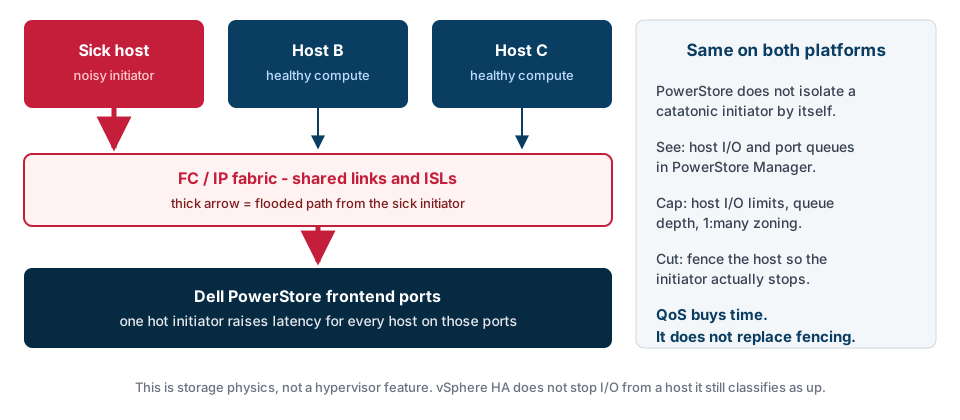
Host I/O limits buy time. They do not replace fencing. This is the same physics on ESXi and on RHCOS.
Install the certified Dell Container Storage Modules (CSM) Operator. Keep the resiliency module off while FAR uses OutOfServiceTaint. Pin spec.version to the sample that matches your operator. Store the array stanza (endpoint, globalID, credentials, blockProtocol) in an ExternalSecret that renders powerstore-config.
1
2
3
4
5
6
7
8
9
10
11
12
13
14
15
16
17
18
19
20
21
22
23
24
25
26
27
apiVersion: storage.dell.com/v1
kind: ContainerStorageModule
metadata:
  name: powerstore
  namespace: powerstore
spec:
  version: v1.16.3
  driver:
    csiDriverType: powerstore
    authSecret: powerstore-config
    replicas: 2
    forceRemoveDriver: true
    csiDriverSpec:
      fSGroupPolicy: ReadWriteOnceWithFSType
      storageCapacity: true
    common:
      imagePullPolicy: IfNotPresent
      envs:
        - name: X_CSI_POWERSTORE_NODE_NAME_PREFIX
          value: csi-node
        - name: X_CSI_POWERSTORE_SKIP_CERTIFICATE_VALIDATION
          value: "true"
        - name: KUBELET_CONFIG_DIR
          value: /var/lib/kubelet
  modules:
    - name: resiliency
      enabled: false
Mark a ReadWriteMany Block class as the Virtualization default. Containerized Data Importer import/clone generally wants Immediate binding.
1
2
3
4
5
6
7
8
9
10
11
12
apiVersion: storage.k8s.io/v1
kind: StorageClass
metadata:
  name: powerstore-vm-rwx-block
  annotations:
    storageclass.kubevirt.io/is-default-virt-class: "true"
provisioner: csi-powerstore.dellemc.com
reclaimPolicy: Delete
allowVolumeExpansion: true
volumeBindingMode: Immediate
parameters:
  arrayID: "<PowerStore-globalID>"
After apply: oc get storageprofile powerstore-vm-rwx-block -o yaml. Claim modes should include ReadWriteMany and Block.
VMs that are allowed to fail over
1
2
3
4
5
6
7
8
9
10
11
12
13
14
15
16
17
18
19
20
21
22
23
24
apiVersion: kubevirt.io/v1
kind: VirtualMachine
metadata:
  name: app-01
  namespace: vm-example
spec:
  runStrategy: Always
  template:
    spec:
      evictionStrategy: LiveMigrate
      domain:
        devices:
          disks:
            - name: rootdisk
              disk:
                bus: virtio
          watchdog:
            name: watchdog0
            i6300esb:
              action: poweroff
      volumes:
        - name: rootdisk
          dataVolume:
            name: app-01-root
In the guest: install watchdog, use /dev/watchdog, enable the service. That covers a hung guest. A hung host is still NHC and FAR. Do not add podmon.dellemc.com/driver: csi-powerstore while FAR OutOfServiceTaint is in use.
See Path B before Ready flips
NHC still keys off Ready. Alert so you page or run a playbook before the fabric melts. Wire Alertmanager to Event-Driven Ansible if you want a human in the loop—not a second uncoordinated remediator.
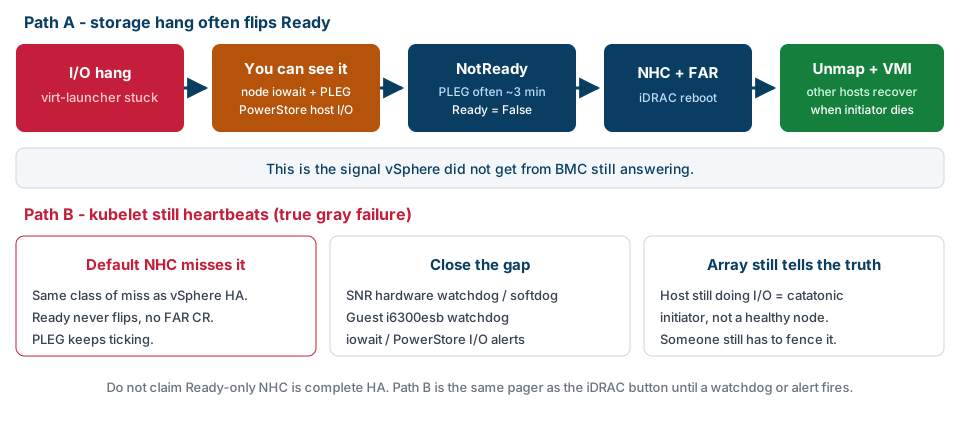
Path A is the automatic fence. Path B is the same class of miss as vSphere HA unless a watchdog or I/O alert fires.
1
2
3
4
5
6
7
8
9
10
11
12
13
14
15
16
17
18
19
20
21
22
23
24
apiVersion: monitoring.coreos.com/v1
kind: PrometheusRule
metadata:
  name: virt-gray-failure
  namespace: openshift-monitoring
spec:
  groups:
    - name: virt-gray-failure
      rules:
        - alert: WorkerStorageIOWaitHigh
          expr: |
            avg by (instance) (rate(node_cpu_seconds_total{mode="iowait"}[5m])) > 0.3
          for: 2m
          labels:
            severity: critical
          annotations:
            summary: High iowait on
        - alert: KubeletPlegSlow
          expr: |
            histogram_quantile(0.99,
              rate(kubelet_pleg_relist_duration_seconds_bucket[5m])) > 10
          for: 2m
          labels:
            severity: warning
Order-of-magnitude time-to-fence, not an SLA: Path A is often about 4–8 minutes with PLEG as the long pole (~3 minutes) plus a 60 second NHC wait and Redfish. vSphere HA in a gray failure is however long it takes a human to notice and reset. Path B without a watchdog is the same human clock. Guest OS boot is extra on both platforms. Measure it in the lab.
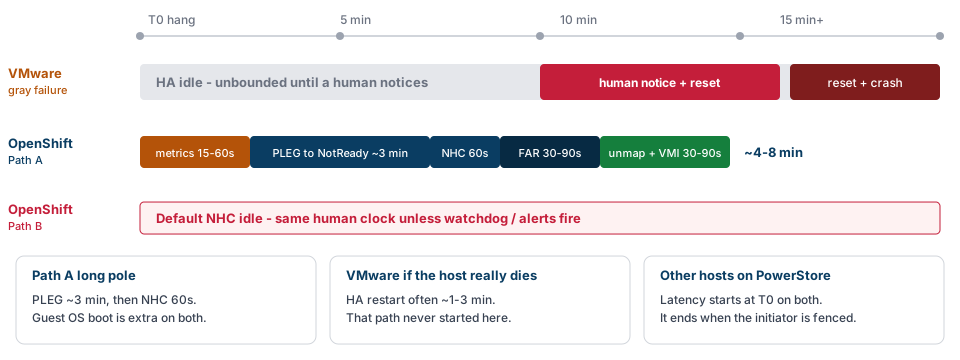
Not an SLA. PLEG is often the long pole on Path A. Guest OS boot is extra on both platforms.
Prove it
Cordon is not the test.
oc get csv -n openshift-workload-availabilityand CSI pods inpowerstoreare healthy.- Each worker has a unique
/etc/nvme/hostnqnand a PowerStore Host object. fence_redfish --action=statusworks for every virt worker iDRAC.- Disposable VM on
powerstore-vm-rwx-blockwithrunStrategy: Always. - Induce
Ready=False(stop kubelet in a debug session, or power-cycle from iDRAC) and watchoc get nhc,far,snr -A, nodes, VMIs, and VolumeAttachments.
Expect a FAR custom resource named after the node, an iDRAC reboot, the out-of-service taint, VolumeAttachments gone, a new virtual machine instance on another worker, and the volume remapped in PowerStore Manager. Other workers’ VM I/O latency should drop when the initiator is fenced—not only when the sick node’s operating system is healthy again.
The solutions architect takeaway
- BMC is a reset button — health is kubelet, PLEG, metrics, and array I/O. vSphere HA keys off management liveness, so this class of failure stays unfenced.
- Detect, fence host, unpublish, then start the VM — never restart a disk-backed VMI while the old QEMU might still write.
- OutOfServiceTaint xor CSM Resiliency — pick one volume-revoke path.
- PowerStore is still a shared fabric — host I/O limits and zoning cap the storm; FAR cuts it. Unique NQNs are not optional.
- Path B is still a gray failure — Ready-only NHC is incomplete without watchdog and I/O alerts.
- Untested
nodeparametersis silent HA —fence_redfish --action=statusbefore production.
Manage operators and NHC through cluster GitOps so drift is a pull request. Keep VM runStrategy with the application repo. Pause NHC during PowerStore NDU. Leave the shipped MachineHealthCheck alone.
Related posts
- Virtualization Autopilot vs GitOps on OpenShift
- Hardening OpenShift Virtualization: First Priorities
- OADP for OpenShift VMs: Backup Is Not DR
- OpenShift Storage Performance: Disks, IOPS, Architectures
Want help mapping NHC, FAR, and PowerStore CSI onto a Virtualization landing zone? Reach out to your Red Hat account team—or prove
fence_redfishand a disposablerunStrategy: AlwaysVM on a non-prod cluster first.